

Teeth names can feel confusing at first. But once you learn them, everything gets simple. Your mouth has different types of teeth. Each one has its own job to do. Some teeth cut food. Some teeth grind food. Others help you speak clearly. In this guide, you will learn every tooth name in easy words.
What Are Teeth Names? A Simple Breakdown
Teeth names describe every tooth in your mouth. Each name shows the tooth’s shape and job. Incisors sit in front. They cut your food. Canines are sharp. They tear food apart.
Premolars crush food into smaller bits. Molars sit at the back. They grind food fully. Adults have 32 teeth total. Kids have 20 teeth first. Knowing teeth names helps you understand your smile better.
All Teeth Names

Human teeth come in several types, and each one has a special shape and job. Some teeth help bite food, while others tear and grind it. Teeth names can also vary by their position in the mouth. The list below includes different tooth-related names and terms.
| Name | Meaning | Origin |
|---|---|---|
| Incisor | A tooth used for cutting | Latin |
| Central Incisor | Front middle cutting tooth | Latin |
| Lateral Incisor | Incisor beside the central tooth | Latin |
| Canine | Pointed tooth used for tearing | Latin |
| Cusp | A pointed part of a tooth | Latin |
| Premolar | Tooth between canine and molar | Latin |
| First Premolar | First tooth in the premolar group | Latin |
| Second Premolar | Second tooth in the premolar group | Latin |
| Molar | Large tooth used for grinding | Latin |
| First Molar | First large grinding tooth | Latin |
| Second Molar | Second large grinding tooth | Latin |
| Third Molar | Last molar in the mouth | Latin |
| Wisdom Tooth | Final molar that appears later | English |
| Crown | Visible upper part of a tooth | Latin |
| Root | Part that holds the tooth in place | Old English |
| Enamel | Hard outer tooth covering | French |
| Dentin | Inner hard layer of a tooth | Latin |
| Pulp | Soft inner tissue of a tooth | Latin |
| Gum | Soft tissue around the teeth | Old English |
| Gingiva | Medical name for gums | Latin |
| Bite | The way upper and lower teeth meet | Old English |
| Jaw Tooth | A tooth positioned in the jaw | English |
| Front Tooth | A tooth at the front of the mouth | English |
| Back Tooth | A tooth at the back of the mouth | English |
| Permanent Tooth | Adult tooth that replaces a baby tooth | Latin |
| Primary Tooth | First set of teeth in children | Latin |
| Deciduous Tooth | Baby tooth that later falls out | Latin |
| Occlusal Surface | Chewing surface of a tooth | Latin |
| Cusp Tip | Pointed top of a tooth | Latin |
| Dental Arch | Curved arrangement of teeth | Latin |
Human Teeth Names
Human teeth are designed to perform different jobs during eating and speaking. The front teeth mainly cut food, while pointed teeth help tear it. The back teeth crush and grind food into smaller pieces. Together, these teeth form a complete and useful dental structure.
| Name | Meaning | Origin |
|---|---|---|
| Incisor | Cutting tooth | Latin |
| Central Incisor | Main front tooth | Latin |
| Lateral Incisor | Side front tooth | Latin |
| Canine | Pointed tearing tooth | Latin |
| Cuspid | Another name for a canine | Latin |
| First Premolar | First tooth behind the canine | Latin |
| Second Premolar | Second tooth behind the canine | Latin |
| First Molar | First large grinding tooth | Latin |
| Second Molar | Second grinding tooth | Latin |
| Third Molar | Last molar | Latin |
| Wisdom Tooth | Late-growing molar | English |
| Maxillary Tooth | Tooth in the upper jaw | Latin |
| Mandibular Tooth | Tooth in the lower jaw | Latin |
| Crown | Visible tooth portion | Latin |
| Root | Anchoring part of a tooth | Old English |
| Enamel | Protective outer layer | French |
| Dentin | Hard layer below enamel | Latin |
| Pulp | Inner living tissue | Latin |
| Cementum | Tissue covering the tooth root | Latin |
| Gingiva | Gum tissue | Latin |
| Alveolus | Socket holding a tooth | Latin |
| Bite | Contact between teeth | Old English |
| Occlusion | The way teeth meet | Latin |
| Dental Arch | Curved row of teeth | Latin |
| Tooth Socket | Space holding a tooth root | English |
| Chewing Tooth | Tooth used for grinding food | English |
| Cutting Tooth | Tooth used to slice food | English |
| Tearing Tooth | Tooth used to tear food | English |
| Permanent Tooth | Long-lasting adult tooth | Latin |
| Primary Tooth | First tooth of childhood | Latin |
Different Teeth Names
Different teeth have different shapes based on the work they perform. Sharp teeth are useful for cutting and tearing food. Broad teeth help crush and grind harder foods. These names describe the main types and important parts of teeth.
| Name | Meaning | Origin |
|---|---|---|
| Incisor | Sharp cutting tooth | Latin |
| Central Incisor | Middle front incisor | Latin |
| Lateral Incisor | Side incisor | Latin |
| Canine | Long pointed tooth | Latin |
| Cuspid | Pointed tooth with one cusp | Latin |
| Premolar | Tooth before the molar | Latin |
| Bicuspid | Tooth with two main cusps | Latin |
| First Premolar | First premolar tooth | Latin |
| Second Premolar | Second premolar tooth | Latin |
| Molar | Wide grinding tooth | Latin |
| First Molar | First major molar | Latin |
| Second Molar | Second major molar | Latin |
| Third Molar | Final molar tooth | Latin |
| Wisdom Tooth | Late-erupting molar | English |
| Deciduous Tooth | Temporary childhood tooth | Latin |
| Permanent Tooth | Adult replacement tooth | Latin |
| Primary Tooth | First natural tooth | Latin |
| Crown | Top visible section | Latin |
| Neck | Area between crown and root | English |
| Root | Lower anchoring section | Old English |
| Enamel | Strong outer coating | French |
| Dentin | Main inner tooth layer | Latin |
| Pulp | Soft central tissue | Latin |
| Cusp | Raised point on a tooth | Latin |
| Ridge | Raised line on a tooth | Old English |
| Groove | Small line between cusps | Old English |
| Fissure | Deep narrow tooth groove | Latin |
| Occlusal Surface | Top chewing area | Latin |
| Lingual Surface | Surface facing the tongue | Latin |
| Buccal Surface | Surface facing the cheek | Latin |
Upper Teeth Names
Upper teeth are located in the upper jaw, also called the maxilla. They work together with the lower teeth during biting and chewing. The upper dental arch contains front and back teeth. Each tooth has a specific position and function.
| Name | Meaning | Origin |
|---|---|---|
| Upper Central Incisor | Middle tooth in the upper front | Latin |
| Upper Lateral Incisor | Side front tooth in the upper jaw | Latin |
| Upper Canine | Pointed upper tearing tooth | Latin |
| Upper First Premolar | First upper premolar | Latin |
| Upper Second Premolar | Second upper premolar | Latin |
| Upper First Molar | First upper grinding tooth | Latin |
| Upper Second Molar | Second upper grinding tooth | Latin |
| Upper Third Molar | Final upper molar | Latin |
| Maxillary Incisor | Incisor in the upper jaw | Latin |
| Maxillary Canine | Canine in the upper jaw | Latin |
| Maxillary Premolar | Premolar in the upper jaw | Latin |
| Maxillary Molar | Molar in the upper jaw | Latin |
| Maxillary Central Tooth | Central upper front tooth | Latin |
| Upper Wisdom Tooth | Last upper molar | English |
| Upper Crown | Visible part of an upper tooth | Latin |
| Upper Root | Root of an upper tooth | English |
| Upper Dental Arch | Curved row of upper teeth | Latin |
| Upper Bite Tooth | Upper tooth involved in biting | English |
| Upper Front Tooth | Front tooth in the upper jaw | English |
| Upper Back Tooth | Back tooth in the upper jaw | English |
| Maxillary Cuspid | Another name for upper canine | Latin |
| Upper Bicuspid | Upper tooth with two cusps | Latin |
| Upper Chewing Tooth | Upper tooth used for chewing | English |
| Upper Grinding Tooth | Upper tooth used for grinding | English |
| Maxillary Crown | Crown of an upper jaw tooth | Latin |
| Maxillary Root | Root of an upper jaw tooth | Latin |
| Upper Primary Tooth | Baby tooth in the upper jaw | Latin |
| Upper Permanent Tooth | Adult tooth in the upper jaw | Latin |
| Upper Molar Crown | Crown of an upper molar | Latin |
| Upper Incisor Edge | Cutting edge of an upper incisor | Latin |
Baby Teeth Names

Baby teeth are the first teeth that develop during childhood. They are also known as primary or deciduous teeth. These teeth help children eat, speak, and develop proper jaw structure. Most baby teeth are later replaced by permanent adult teeth.
| Name | Meaning | Origin |
|---|---|---|
| Baby Tooth | A tooth that appears during childhood | English |
| Primary Tooth | First set of teeth | Latin |
| Deciduous Tooth | Temporary tooth that falls out | Latin |
| Milk Tooth | Common name for a baby tooth | English |
| Primary Incisor | Baby cutting tooth | Latin |
| Primary Central Incisor | Middle baby front tooth | Latin |
| Primary Lateral Incisor | Side baby front tooth | Latin |
| Primary Canine | Baby pointed tooth | Latin |
| Primary Cuspid | Another name for baby canine | Latin |
| Primary First Molar | First baby grinding tooth | Latin |
| Primary Second Molar | Second baby grinding tooth | Latin |
| Upper Baby Incisor | Baby incisor in the upper jaw | English |
| Lower Baby Incisor | Baby incisor in the lower jaw | English |
| Upper Baby Canine | Baby canine in the upper jaw | English |
| Lower Baby Canine | Baby canine in the lower jaw | English |
| Upper Baby Molar | Baby molar in the upper jaw | English |
| Lower Baby Molar | Baby molar in the lower jaw | English |
| Milk Incisor | Front milk tooth | English |
| Milk Canine | Pointed milk tooth | English |
| Milk Molar | Grinding milk tooth | English |
| Baby Crown | Visible part of a baby tooth | English |
| Baby Root | Root of a baby tooth | English |
| Primary Dental Arch | First curved row of teeth | Latin |
| Deciduous Incisor | Temporary cutting tooth | Latin |
| Deciduous Canine | Temporary pointed tooth | Latin |
| Deciduous Molar | Temporary grinding tooth | Latin |
| Eruption Tooth | Tooth emerging through the gums | Latin |
| Shedding Tooth | Tooth ready to fall out | English |
| Replacement Tooth | Adult tooth replacing a baby tooth | English |
| Mixed Dentition | Stage with baby and adult teeth | Latin |
Bottom Teeth Names
Bottom teeth are located in the lower part of the mouth. They are attached to the lower jaw and support biting and chewing. These teeth meet the upper teeth to process food. Their names depend on their type and position.
| Name | Meaning | Origin |
|---|---|---|
| Bottom Central Incisor | Middle front tooth in the lower jaw | English |
| Bottom Lateral Incisor | Side front tooth in the lower jaw | English |
| Bottom Canine | Pointed lower tooth | English |
| Bottom First Premolar | First lower premolar | English |
| Bottom Second Premolar | Second lower premolar | English |
| Bottom First Molar | First lower grinding tooth | English |
| Bottom Second Molar | Second lower grinding tooth | English |
| Bottom Third Molar | Last lower molar | English |
| Bottom Wisdom Tooth | Final lower molar | English |
| Lower Incisor | Cutting tooth in the lower jaw | English |
| Lower Canine | Tearing tooth in the lower jaw | English |
| Lower Premolar | Premolar in the lower jaw | English |
| Lower Molar | Molar in the lower jaw | English |
| Mandibular Incisor | Lower jaw cutting tooth | Latin |
| Mandibular Canine | Lower jaw pointed tooth | Latin |
| Mandibular Premolar | Lower jaw premolar | Latin |
| Mandibular Molar | Lower jaw grinding tooth | Latin |
| Bottom Front Tooth | Front tooth at the bottom | English |
| Bottom Back Tooth | Back tooth at the bottom | English |
| Bottom Chewing Tooth | Lower tooth used for chewing | English |
| Bottom Grinding Tooth | Lower tooth used for grinding | English |
| Bottom Crown | Visible part of a lower tooth | English |
| Bottom Root | Anchoring root of a lower tooth | English |
| Lower Dental Arch | Curved row of lower teeth | Latin |
| Mandibular Arch | Dental arch of the lower jaw | Latin |
| Lower Bicuspid | Lower premolar with two cusps | Latin |
| Lower Cuspid | Another name for lower canine | Latin |
| Lower Primary Tooth | Baby tooth in the lower jaw | Latin |
| Lower Permanent Tooth | Adult tooth in the lower jaw | Latin |
| Lower Incisal Edge | Cutting edge of a lower incisor | Latin |
Lower Teeth Names

Lower teeth form the dental arch of the mandibular jaw. They include incisors, canines, premolars, and molars. Every type helps with biting, tearing, or grinding food. Proper alignment helps the lower and upper teeth work smoothly together.
| Name | Meaning | Origin |
|---|---|---|
| Mandibular Central Incisor | Middle lower front tooth | Latin |
| Mandibular Lateral Incisor | Side lower front tooth | Latin |
| Mandibular Canine | Pointed lower tearing tooth | Latin |
| Mandibular First Premolar | First premolar in the lower jaw | Latin |
| Mandibular Second Premolar | Second premolar in the lower jaw | Latin |
| Mandibular First Molar | First lower grinding tooth | Latin |
| Mandibular Second Molar | Second lower grinding tooth | Latin |
| Mandibular Third Molar | Final lower molar | Latin |
| Lower Wisdom Tooth | Last molar in the lower jaw | English |
| Lower Central Tooth | Middle tooth in the lower arch | English |
| Lower Side Tooth | Tooth beside the lower center | English |
| Lower Cuspid | Another name for a lower canine | Latin |
| Lower Bicuspid | Lower premolar with two cusps | Latin |
| Lower Front Tooth | Tooth at the lower front | English |
| Lower Back Tooth | Tooth at the lower back | English |
| Lower Chewing Tooth | Tooth used for chewing | English |
| Lower Grinding Tooth | Tooth used for grinding | English |
| Mandibular Crown | Visible part of a lower tooth | Latin |
| Mandibular Root | Anchoring part of a lower tooth | Latin |
| Lower Enamel | Outer protective layer | English |
| Lower Dentin | Inner hard tooth layer | English |
| Lower Pulp | Inner soft tooth tissue | English |
| Lower Dental Arch | Curved arrangement of lower teeth | Latin |
| Mandibular Arch | Lower jaw tooth arch | Latin |
| Lower Primary Incisor | Baby cutting tooth in the lower jaw | Latin |
| Lower Primary Canine | Baby pointed tooth in the lower jaw | Latin |
| Lower Primary Molar | Baby grinding tooth in the lower jaw | Latin |
| Lower Permanent Incisor | Adult cutting tooth in the lower jaw | Latin |
| Lower Permanent Canine | Adult pointed tooth in the lower jaw | Latin |
| Lower Permanent Molar | Adult grinding tooth in the lower jaw | Latin |
Front Teeth Names
Front teeth are the most visible teeth when a person smiles. They mainly help bite and cut food into smaller pieces. The front section usually includes incisors and canines. Their appearance also plays an important role in speech and facial aesthetics.
| Name | Meaning | Origin |
|---|---|---|
| Central Incisor | Main middle front tooth | Latin |
| Lateral Incisor | Front tooth beside the center | Latin |
| Upper Central Incisor | Middle upper front tooth | Latin |
| Lower Central Incisor | Middle lower front tooth | Latin |
| Upper Lateral Incisor | Side upper front tooth | Latin |
| Lower Lateral Incisor | Side lower front tooth | Latin |
| Front Canine | Pointed tooth near the front | English |
| Upper Canine | Pointed tooth in the upper front area | Latin |
| Lower Canine | Pointed tooth in the lower front area | Latin |
| Cuspid | Another name for a canine | Latin |
| Front Incisor | Cutting tooth at the front | Latin |
| Cutting Tooth | Tooth used to slice food | English |
| Biting Tooth | Tooth used to bite food | English |
| Smile Tooth | Visible tooth when smiling | English |
| Anterior Tooth | Tooth located toward the front | Latin |
| Anterior Incisor | Front cutting tooth | Latin |
| Anterior Canine | Front pointed tooth | Latin |
| Upper Front Tooth | Tooth at the upper front | English |
| Lower Front Tooth | Tooth at the lower front | English |
| Front Dental Arch | Front section of the tooth arch | Latin |
| Incisal Edge | Sharp edge of an incisor | Latin |
| Front Crown | Visible crown of a front tooth | English |
| Front Root | Root of a front tooth | English |
| Primary Front Tooth | Baby tooth at the front | Latin |
| Permanent Front Tooth | Adult tooth at the front | Latin |
| Primary Incisor | Baby cutting tooth | Latin |
| Permanent Incisor | Adult cutting tooth | Latin |
| Central Smile Tooth | Main visible front tooth | English |
| Side Smile Tooth | Visible tooth beside the center | English |
| Anterior Dentition | Group of front teeth | Latin |
Dog Teeth Names
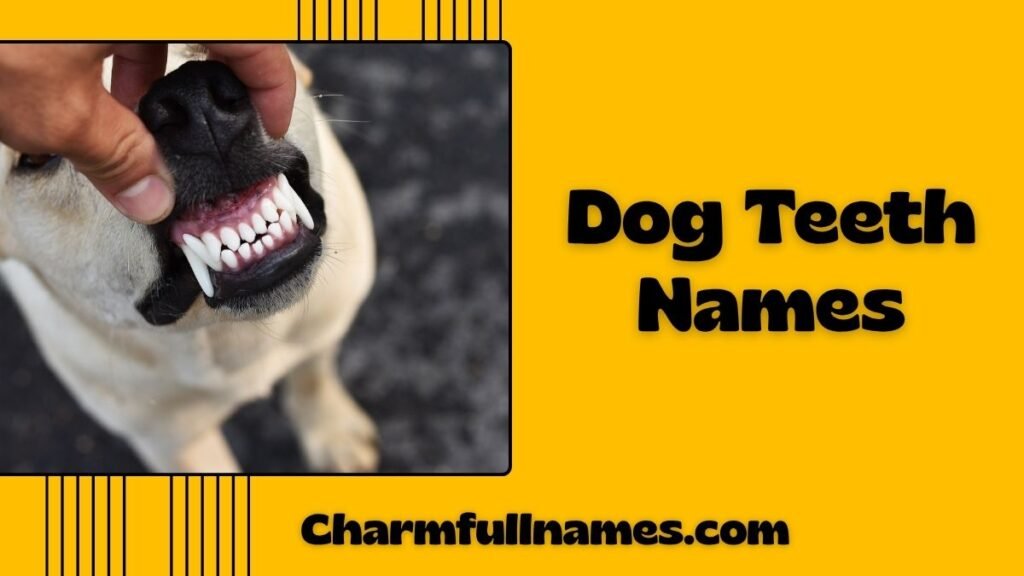
Dog teeth are commonly called canines because they are pointed and sharp. In humans, canine teeth help tear food into smaller pieces. The name is linked to the prominent teeth found in dogs. These teeth are positioned between the incisors and premolars.
| Name | Meaning | Origin |
|---|---|---|
| Canine | Pointed tooth used for tearing | Latin |
| Cuspid | Tooth with a single pointed cusp | Latin |
| Eye Tooth | Common name for an upper canine | English |
| Dog Tooth | Common name for a canine tooth | English |
| Upper Canine | Canine located in the upper jaw | Latin |
| Lower Canine | Canine located in the lower jaw | Latin |
| Maxillary Canine | Upper jaw canine | Latin |
| Mandibular Canine | Lower jaw canine | Latin |
| Primary Canine | Baby canine tooth | Latin |
| Permanent Canine | Adult canine tooth | Latin |
| Deciduous Canine | Temporary canine tooth | Latin |
| Tearing Tooth | Tooth used to tear food | English |
| Pointed Tooth | Tooth with a sharp tip | English |
| Cusp Tooth | Tooth with a raised point | Latin |
| Canine Crown | Visible upper part of a canine | Latin |
| Canine Root | Anchoring root of a canine | Latin |
| Canine Cusp | Pointed tip of a canine | Latin |
| Upper Cuspid | Upper pointed canine tooth | Latin |
| Lower Cuspid | Lower pointed canine tooth | Latin |
| Human Canine | Canine tooth in humans | Latin |
| Primary Cuspid | Baby pointed canine | Latin |
| Permanent Cuspid | Adult pointed canine | Latin |
| Maxillary Cuspid | Another name for an upper canine | Latin |
| Mandibular Cuspid | Another name for a lower canine | Latin |
| Canine Ridge | Raised feature near a canine | Latin |
| Canine Arch | Position of canines in the dental arch | Latin |
| Anterior Canine | Canine located toward the front | Latin |
| Upper Eye Tooth | Common name for an upper canine | English |
| Lower Dog Tooth | Common name for a lower canine | English |
| Canine Dentition | Arrangement of canine teeth | Latin |
Cat Teeth Names
Cat teeth are specially shaped for catching and eating food. Their sharp incisors and canines help grip and tear. Premolars and molars help cut food into smaller pieces. Cat dental names are generally based on the same main tooth types used in veterinary anatomy.
| Name | Meaning | Origin |
|---|---|---|
| Cat Incisor | Small front tooth of a cat | English |
| Cat Canine | Long pointed tooth of a cat | English |
| Cat Premolar | Tooth used for cutting food | English |
| Cat Molar | Back tooth used for processing food | English |
| Feline Incisor | Front tooth in a cat | Latin |
| Feline Canine | Pointed tearing tooth in a cat | Latin |
| Feline Premolar | Premolar of a cat | Latin |
| Feline Molar | Molar of a cat | Latin |
| Kitten Tooth | Tooth of a young cat | English |
| Kitten Incisor | Baby front tooth of a kitten | English |
| Kitten Canine | Baby pointed tooth of a kitten | English |
| Kitten Premolar | Baby premolar of a kitten | English |
| Deciduous Feline Tooth | Temporary cat tooth | Latin |
| Permanent Feline Tooth | Adult cat tooth | Latin |
| Feline Cuspid | Another term for a cat canine | Latin |
| Carnassial Tooth | Specialized cutting tooth in carnivores | Latin |
| Upper Carnassial | Major cutting tooth in the upper jaw | Latin |
| Lower Carnassial | Major cutting tooth in the lower jaw | Latin |
| Feline Crown | Visible part of a cat tooth | Latin |
| Feline Root | Anchoring part of a cat tooth | Latin |
| Feline Enamel | Protective outer tooth layer | Latin |
| Feline Dentin | Hard inner tooth layer | Latin |
| Feline Pulp | Soft inner tooth tissue | Latin |
| Cat Front Tooth | Tooth at the front of a cat’s mouth | English |
| Cat Back Tooth | Tooth at the back of a cat’s mouth | English |
| Cat Tearing Tooth | Sharp tooth used for tearing | English |
| Cat Cutting Tooth | Tooth used for slicing food | English |
| Feline Dental Arch | Curved arrangement of cat teeth | Latin |
| Primary Feline Tooth | First set of cat teeth | Latin |
| Adult Feline Tooth | Permanent tooth of an adult cat | Latin |
Tips for Learning Teeth Names
Learning teeth names is easy once you know the basics. Each tooth has a job and a place. This helps you talk about your teeth with ease. Use these tips to remember them fast.
- Learn one tooth type at a time.
- Use a mirror to see your own teeth.
- Say each name out loud.
- Match each name to its job.
Conclusion
Teeth names are simple once you break them down. Each tooth has its own job, from cutting to grinding food. Knowing these names helps you understand your smile and talk to your dentist with ease.
Whether it’s incisors, canines, premolars, or molars, every tooth plays a part. Keep this guide handy next time you want to learn more about your teeth.
FAQ’s
How many teeth do adults have?
Adults usually have 32 teeth in total.
What are the four main types of teeth?
The four main types are incisors, canines, premolars, and molars.
Do kids have the same teeth as adults?
No. Kids have 20 baby teeth, fewer than adults.
Which tooth is used for tearing food?
Canines are the teeth used for tearing food.
Why are wisdom teeth called that?
Wisdom teeth are called that because they grow in later in life.


Pingback: Mexican Girl Names Full of Culture and Charm